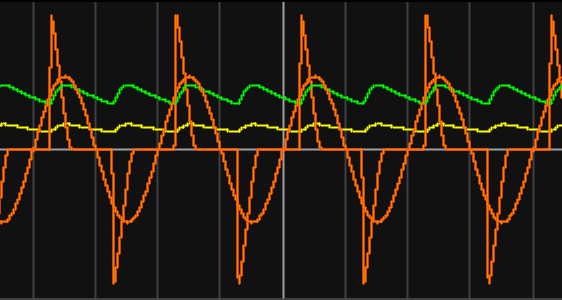
After AC Rectification, the next step is Reducing the Ripple on the DC supply line as much as possible.
Electronics
15 posts

AC (Alternating Current) is used for the transmission of mains voltage, one of its main advantages for use as a method of transmission over DC (Direct Current) is that a change of voltage between High Voltage, Low Voltage, and SELV (Safety Extra-low Voltage) can be performed using a transformer. A […]

Ohm’s law (sometimes written as Ohm law or Ohms law) is one of the fundamental first principles of electronics. The law was named after the German physicist Georg Ohm and states that the electric current through a conductor between two points is directly proportional to the voltage across the two […]

I would consider handing a candidate in the UK a BS 1363 Plug, a length of flex, and an appropriate selection of tools and asking them to wire the plug, and then present the finished task. This quick interview task would allow you to see a candidate’s ability to ask […]

For some reason a list of links to other peoples blogs is called a blogroll (I am not sure if links to sites made in software that is not blogging software is also a blogroll, but YMMV)… so here is my PiWars blogroll. Since I got accepted as a backup […]

Nathaniel Poate of Team Shortcircuit Robot Bits supplied me with five drill motors, these are drill motors from cordless battery-powered drills. Three of them are 12 V, and the remaining two are 18 V motor and gearbox sets, these were given to me for use with robotics projects. I received […]

After the Origin issue, another one of KiCad’s slight annoyances is when the contents of the paper space title blocks get out of sync, looking at the support tickets, this is by design, however, it doesn’t stop it from being an annoying “feature”. This is especially problematic when you go […]

When you have been using KiCad for a while to make PCBs, one of the things you will come to find is a pain is that by default the KiCad grid origin is set up in the top left of the Paper Space, which makes it a bit of a […]

I have put my registration in for PiWars 2024 – Disaster Zone. PiWars is “The Raspberry Pi Robotics Competition”. PiWars is a Non-Destructive robotics competition run by members of the Cambridge Raspberry Jam. It will be held on Saturday 20th and Sunday 21st April 2024, in Cambridge UK. Full details […]

I can’t quite remember how long I have been interested in seeing what is under the water, I have been writing my thoughts about building an ROV on my old site for a while. I picked up a copy of the book, “The ROV Manual – A user guide for […]

My preferred ECAD software is KiCad. It is now at version seven, and over recent years has been developed to be more and more powerful. I used to use CadSoft Eagle CAD until it was taken over by Autodesk and became part of Fusion 360. I use KiCad for both […]

Contactors are more than just a large relay, their internal construction is designed to be capable of carrying far higher currents and “making and breaking” on large loads. Rather than moving the common contact back and forth on a pivoting armature, contactors move a large bar towards or away from […]