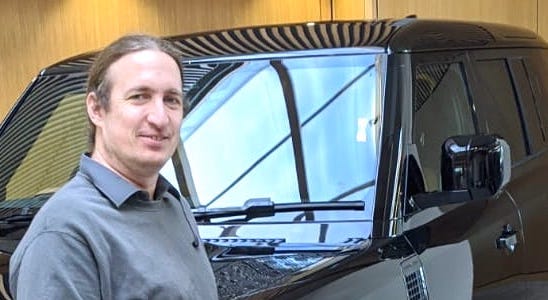
Philip McGaw has over a decade of professional electronics experience, in EMC, Testing and Research and Development
Philip enjoys working within a fast-paced R&D environment developing innovative solutions to allow for testing complex systems within regulatory framework testing, Hardware in the Loop, or production line testing of prototypes through to final products.
Philip can apply his Electrical and Electronic Systems Engineering backgrountld and his skills in 3D Printing, rapid prototyping and Embedded Systems to develop and test innovative hardware solutions for Devices under test, recently this has included Electric Vehicles and Electric Vehicle Supply Equipment. Previously this also included hardware supplied for testing by customers.
You can view Philip McGaw’s LinkedIn Profile for more information
Philip McGaw’s Recent Posts
- How to measure cable loss using an ESR7To more accurately measure emissions from a DUT (Device Under Test), it is wise to calculate the path loss, or cable loss, from the receiving device, whether that is a LISN, a Current Clamp, or an antenna. We can do this by using the tracking generator on the EMI receiver or the Spectrum Analyser. At work, we have an R&S ESR7 EMI test receiver with a Schwarzbeck VTSD 9561-F attenuator on the low-frequency input. This attenuator lists its frequency range as between DC and 200 MHz, with an attenuation of 10 dB. I wanted to know the loss above 200… Read more: How to measure cable loss using an ESR7
- My Basic Linux SetupAt the same time as sorting out Passwordless Sudo on my Ubuntu virtual machine, I am trying to make it match my fairly default Raspberry Pi or other Linux box setup. My default username on a Raspberry Pi is still ‘pi’, not for any real reason other than nostalgia. And because it is easy to remember. Since this virtual machine is called “Fake Raspberry Pi”, the user for it is also pi. Some of these instructions are not required when using the Raspberry Pi Linux software natively Basic Linux housekeeping Before we do anything else, we will make sure the… Read more: My Basic Linux Setup
- Passwordless SudoAt home, I have a Raspberry Pi that I use to develop my ROV and K-9 software. Raspbian seems to have passwordless sudo, meaning you don’t have to enter the user’s password to run a command as root. I share this development machine with my wife, Tamarisk. In the interest of getting some more of the code written, at the expense of having a development machine available for some of the work while I am not at home, I have installed Ubuntu Server on a VirtualBox Virtual machine. The default setup is that to run a command as ‘sudo’, you… Read more: Passwordless Sudo
- DIN 72552Since quite a lot of traffic to this site is related to the meaning of automotive terminal designators, What is KLR, KL15, KL50, KL30, and KL31? and More about KL15, KL30, KL31, KL61, etc, it is probably worth my listing all the pins in the DIN 72552 standard. DIN stands for “Deutsches Institut für Normung”, which in English translates to German Institute for Standardisation. Like the BSI in the UK or similar organisations, it is a member of ISO. Quite often, ‘DIN’ is incorrectly expanded as Deutsche Industrienorm (“German Industry Standard”). DIN 72552 “Standard for labelling the electric terminals in… Read more: DIN 72552
- Programming an Arduino from the command lineAs part of my K9 and ROV projects, I am using at least one Arduino to control components such as the K9’s ears. Since the Arduinos will be fixed to the robots, I will program them via the Raspberry Pi. The version of Raspbian I am running is Raspberry Pi OS Lite, which does not have a Graphical User Interface, so we will need to install the Arduino command-line tools. Configure Arduino command-line IDE After a fairly default install, you will still need to install the specific parts for working with the Arduino. So log into the Raspberry Pi Linux… Read more: Programming an Arduino from the command line
Philip McGaw’s previous responsibilities
Projects that Philip McGaw has worked on previously have included:
- Commissioning of the new EMC, and electrical test facilities
- Designing EV EVSE test equipment.
- Development of design validation plans (DVP) and procedures for Electric vehicles (EV) components to meet industry standards [ISO 16750, CISPR 25, ECE Regulation 10, ISO 10605, ISO 11452, ISO 7637] and company requirements.
- Performing validation tests for EV components – HV traction inverters, ECU, DCDC, BMS, ADAS, HMI, etc.) .
- Performing R&D and functional tests, fault analysis for new EV component designs.
- Performing tests with Vector CANalyzer environment, Python, and Matlab/Simulink scripts.
- Preparation and release of test reports, hardware bug tracking via Atlassian Jira/Confluence


