
Plotting EMC limit charts in Microsoft Excel is unfortunately quite hard, Standards like CISPR 11 and CISPR 25 make use of Log/Log graphs.
Blog Posts
57 posts

Make an item of test equipment that can respond to SCPI (IEEE-488.1) commands. including *IDN?, *OPT? and *TST

To encode the Hardware Revision number, so that we know what the version numbers of the main PCB is and is available to the Microcontroller.

we use the "ArduinoUniqueID" Arduino library, to give us the Unique ID serial number of the Arduino we are using.

KL15, KL30, KL31, KL61 - KL is the abbreviation for 'klemme' which is the German term for connector/connection…

It is helpful to know when the firmware on the device was compiled, it can be displayed on a screen, or sent viewed over serial.
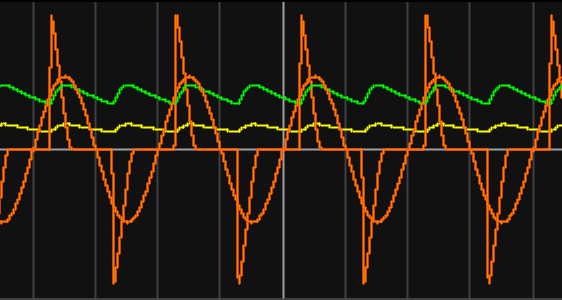
After AC Rectification, the next step is Reducing the Ripple on the DC supply line as much as possible.

AC (Alternating Current) is used for the transmission of mains voltage, one of its main advantages for use as a method of transmission over DC (Direct Current) is that a change of voltage between High Voltage, Low Voltage, and SELV (Safety Extra-low Voltage) can be performed using a transformer. A […]

For the Charging Two EVs on One EVSE project, I will need a Vehicle Inlet ‘Male’ type EV charging connector for the upstream supply from the existing EVSE. And two EVSE ‘Female’ type EV connectors to allow for connection to the downstream vehicles, Since we are in the UK I […]

Like an increasing number of people, we have one home EV charger but have two EVs. My 2015 Nissan Leaf has a range of about 60 miles, which is perfect for daily school runs, and trips to the office. However, this means that most nights I need to put it […]

Following on from my quick overview of Proximity Pilot and Control Pilot, we will need to dig a little deeper into the functionality of CP/PP to talk about how to make some circuits for a minimalist EVSE (Electric Vehicle Supply Equipment). I would not recommend using this in production as […]

An EV emulator or EVSE test box is a device that you can use to test EVSE equipment. it allows you to change between different charge states and cable configurations. It will also allow you to draw current from EVSE equipment, as well as offering through normal valid states, An […]